


Hello,
I’m trying to use esp32(NodeMcu-32s) along with VNH5019 motor driver and <DualVNH5019MotorShield.h> to control a DC linear actuator, but i keep getting md.getM1Fault() and the motor doesn’t move, can anyone suggest what the issue might be and how to solve it.
the code I use is posted belbow, and the electric layout is provided.
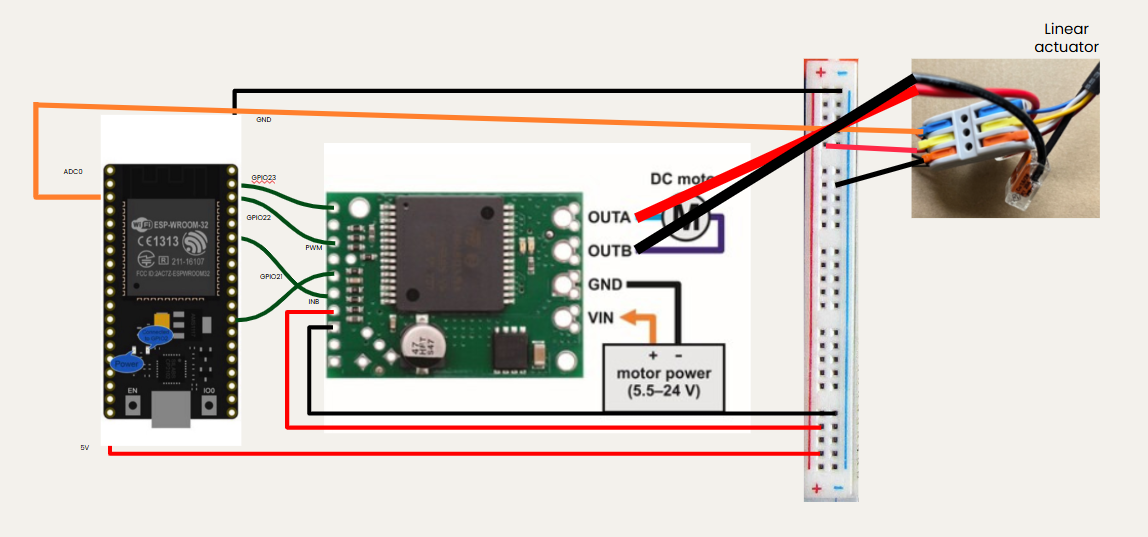
#include <DualVNH5019MotorShield.h>

#define LA_POSITION_PIN 36   // Your actuator potentiometer analog pin (ESP32 example: GPIO36)

DualVNH5019MotorShield md(
    23, 21, 16, 22, 255,     // M1INA, M1INB, EN/DIAG, M1PWM, M1CS
    255,255,255,255,255      // M2 unused
);

const float Kp = 10.0;
const int MIN_EFFORT = 30;
const int MAX_EFFORT = 400;
const float STOP_TOLERANCE = 2.5;

int targetPosition = -1;
bool running = false;

void setup() {
  Serial.begin(115200);
  delay(2000);

  md.init();

  int initialPos = analogRead(LA_POSITION_PIN);
  Serial.print("Initial LA Position = "); Serial.println(initialPos);

  Serial.println("Type target ADC value (e.g. 567) and press Enter.");
  Serial.println("Actuator will move to that position and hold it.");
}

void loop() {
  // Serial input: parse target position
  if (Serial.available() > 0) {
    String cmd = Serial.readStringUntil('\n');
    cmd.trim();
    if (cmd.length() > 0 && cmd.toInt() >= 0) {
      targetPosition = cmd.toInt();
      running = true;
      Serial.print("New target position: "); Serial.println(targetPosition);
    }
  }

  // --- Fault check ---
  if (md.getM1Fault()) {
    md.setM1Brake(400);
    Serial.println("M1 FAULT detected! Motor STOPPED.");
    running = false;
    while (1) {
      // Optionally, continue reporting fault or add blink, etc.
      delay(500);
    }
  }

  if (targetPosition >= 0) {
    int currentPosition = analogRead(LA_POSITION_PIN);
    int error = targetPosition - currentPosition;
    int effort = int(Kp * error);

    // Deadzone compensation
    if (abs(effort) > 0 && abs(effort) < MIN_EFFORT)
      effort = (effort > 0) ? MIN_EFFORT : -MIN_EFFORT;
    effort = constrain(effort, -MAX_EFFORT, MAX_EFFORT);

    Serial.print("Target: "); Serial.print(targetPosition);
    Serial.print(" | Position: "); Serial.print(currentPosition);
    Serial.print(" | Error: "); Serial.print(error);
    Serial.print(" | Effort: "); Serial.print(effort);

    Serial.print(", INA: ");  Serial.print(digitalRead(23) == HIGH ? "H" : "L");
    Serial.print(", INB: ");  Serial.print(digitalRead(21) == HIGH ? "H" : "L");
    Serial.print(", PWM: ");  Serial.print(digitalRead(22) == HIGH ? "H" : "L");
    Serial.println();

    if (abs(error) > STOP_TOLERANCE) {
      md.setM1Speed(effort);
    } else {
      md.setM1Speed(0);
      if (running) {
        Serial.println("Target reached. Motor stopped.");
        running = false;
      }
    }
  } else {
    md.setM1Speed(0);
  }

  delay(50);
}