


I need a motor that can twist a bearing that is horizontal. The outer race of the bearing has chainrings so that It can be moved using a bike chain. I will design a chainring to go around the motor that I buy also, but I’m not sure which motor or driver I should use. It will need to move a lot of weight, (100lbs) but it doesn’t necessarily need to move very fast. Let me know if you have any ideas to help me out. Thanks.
Hello.
It is not exactly clear what you are planning to use your motor for (some drawings/diagram or pictures of the setup so far would probably be helpful), but barring some analysis to make sure the torque you need is appropriate for our motors and that the 100 pound weight of your load is decoupled from the output shaft of the motor, our brushed DC motors are likely underpowered for your application. As a reference point, the recommended upper limit for continuously applied loads is 10kg-cm (150oz-in) for our 37D gearmotors (which is our most powerful family of brushed DC motors).
We do have linear actuators that are designed to handle much higher loads akin to what it sounds like you have in your setup, but it is not immediately clear to me if that would be a practical option.
- Patrick
Thank you for responding so quickly. Here are hopefully more understandable specifications for the setup of the bearing it will be pushing:
- Mechanism: Horizontal chain ring and platform supported by bearings
- Platform Diameter: 10 1/4 inches
- Supported Weight: Approximately 120 lbs.
- Gear Teeth: 63 teeth
It is similar to an e-bike but horizontal, and supporting around 120lbs of weight. The weight will be decoupled from the motor, and I also attached an image which might be helpful. I labeled where the motor would go, and the dimensions stated earlier are depicting the bearing it will be moving. If anything is unclear or you need any additional information, please let me know!
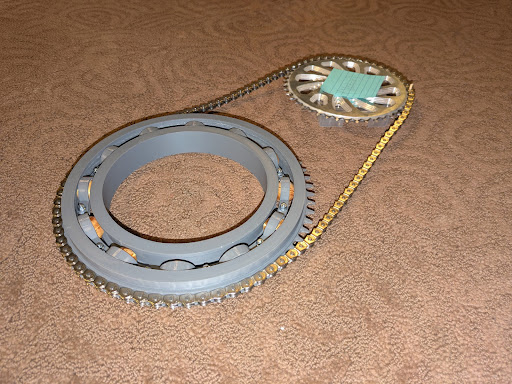
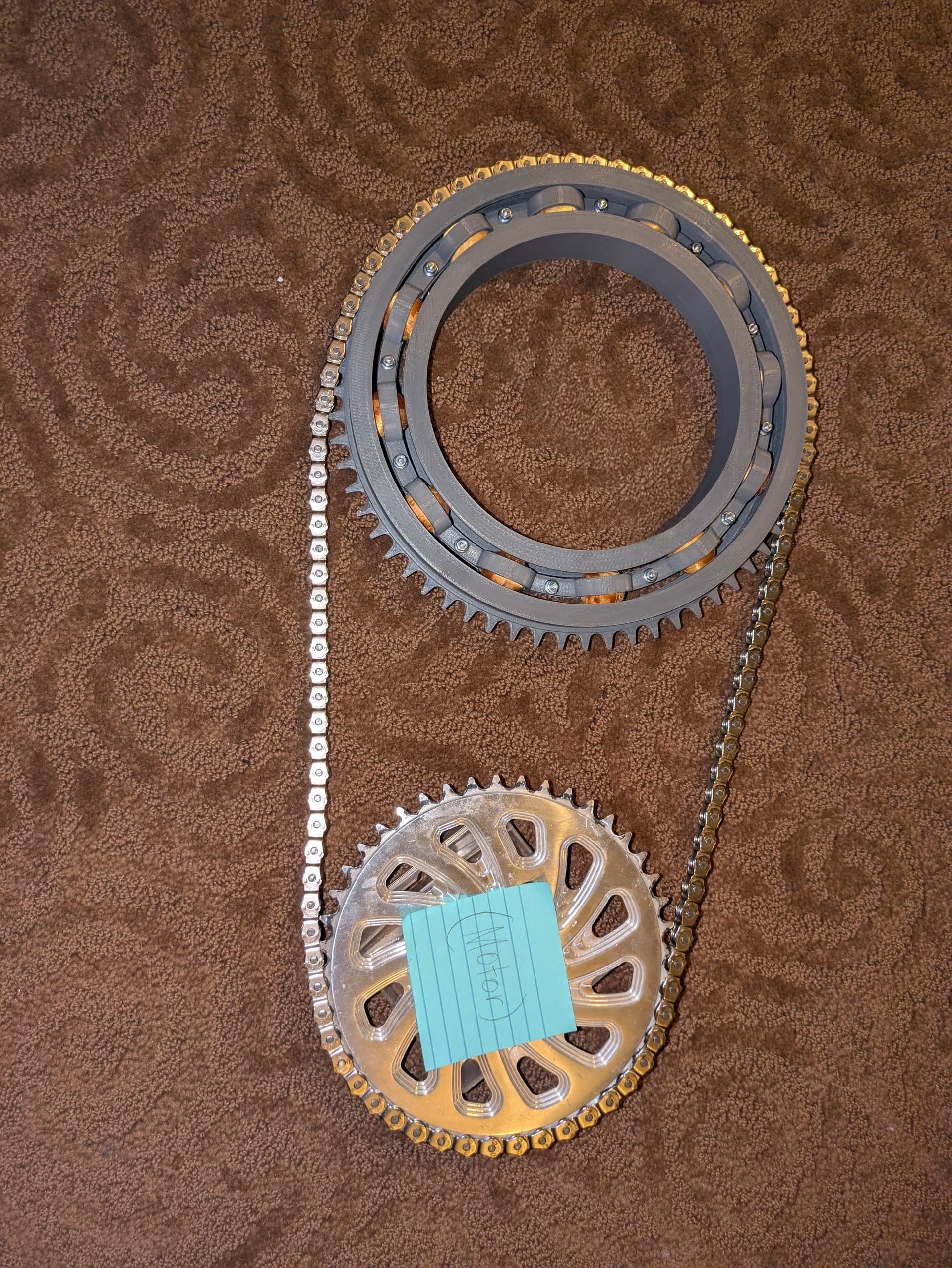
The pictures make your setup much clearer; thanks.
Since the motor is decoupled from the weight and just rotating the load (rather than lifting it), that makes it more plausible that one of our motors might work. However, you are still dealing with a lot of inertia, and I am not sure how much friction to expect in your setup, so I recommend characterizing your torque requirements. If you are not familiar with that kind of thing, then you could start by reading this “Force and torque” blog post, but I would also try to research projects that are similar to yours and finding out what motors they use. Finding a comparable example should at least help you figure out whether a 5-10W motor will be okay, or if you should actually be looking at motors capable of a few hundred Watts.
Once you decide on a motor, you can post a link to it or its specifications along with information about how you want to control it (supply voltage, control interface, etc.) and I can let you know if any of our brushed DC motor drivers or motor controllers would be suitable.
- Patrick
Hi Patrick,
Thanks for pointing me to the “Force and torque” post! Based on my setup, here are a few more details regarding speed and operation:
- Target Speed: I am aiming for a top platform rotation speed of roughly 10 RPM.
- Acceleration: I’d like it to reach full speed in about 1 second from a standstill.
- Drive Setup: My horizontal bearing platform has a 63-tooth chainring. I am planning to mount a smaller sprocket (around 14 teeth) on the motor shaft, giving roughly a 4.5:1 chain reduction.
- Power Supply & Control: I plan to power this using a 12V DC power supply. I would like to control the motor using [mention your intended control method, e.g., a microcontroller like an Arduino / a simple potentiometer dial / USB control from a computer].
Given that the 120 lb load is supported horizontally on bearings (so torque is mainly needed to overcome static friction and accelerate the mass), do you think one of your 37D gearmotors (e.g., 30:1 or 50:1 ratio) with an appropriate driver would be suitable for this, or should I look into a heavier-duty solution?
Which specific motor driver or controller would you recommend for this setup?
Thanks!
Hello.
As I mentioned previously, I recommend you try researching similar projects and see what kinds of motors they use.
It is still not clear exactly how you want to control your motor (it looks like you maybe copy/pasted some incomplete statement by mistake), but any recommendation for that depends on the particular motor you decide to use, so I recommend you determine that first.
- Patrick
Hi Patrick,
Sorry about the formatting mix-up in my last post!
I have selected the motor and control method for my build:
- Motor Selection: I am looking to use the 37D mm Metal Gearmotor (12V) with a 50:1 gear ratio (or similar 30:1–50:1 ratio range).
- Control Method: I plan to control the motor using an Arduino (PWM signal) to adjust speed and direction.
- Power Supply: 12V DC power supply.
Given this setup (a 12V 37D gearmotor driven via Arduino PWM), could you recommend which specific Pololu motor driver board or controller board would be best suited for this motor and project?
Thanks!
We have several motor drivers that work with our 37D gearmotors, and you can find some suggestions for that by looking at the information on the motor’s product page under the “Gearmotor accessories” header or the list of related products.
A conservative guideline for motor driver selection is to choose a driver or controller that can continuously handle your motor’s stall current; that way the motor driver is unlikely to be damaged in the unfortunate event of a prolonged stall (though keep in mind that the motor is still likely to be damaged in that event unless you have some other protection mechanism at work). That also ensures the driver will not limit the motor power. Following that guideline, you might consider our VNH5019 carrier. Please note however that you will need more than just a single PWM signal to use that driver. (Speed is adjusted with a PWM signal, but setting the direction requires two additional digital signals).
- Patrick
Hi Patrick,
Thanks again for all the help. I’ve been learning more about how the motor, gearing, torque, and motor driver work, and I realized I made a few things sound more finalized than they actually are in my earlier messages.
The 50:1 37D motor, the 63-tooth and 14-tooth sprockets, and the Arduino were all more like ideas I was using while trying to figure everything out, rather than parts I had actually decided on. I’m currently thinking of using an ESP32 instead, but I’m still figuring out the motor and driver first.
The motor is going to turn a bearing-supported rotating assembly using a bicycle-style chain and sprockets. The bearing supports the vertical load, so the motor mainly needs to rotate the assembly rather than support the weight itself. The final sprocket ratio can also be changed depending on what works best with the motor.
I would like the final rotating speed to be around 90 degrees per second, or about 15 RPM. It needs to be able to rotate continuously in either direction, and I would like it to get up to speed and slow down fairly quickly, although I can adjust that in software while testing it.
One thing I still don’t know is exactly how much torque the mechanism will need since I haven’t built the full mechanical version yet. I don’t want to just guess a number and choose the wrong motor because of it. Is there a measurement or information you would recommend getting to help figure out the torque requirement?
Based on what I know so far, do you think the 37D motors are still a reasonable place to start, or would you recommend looking at a different size motor? If the 37D motors could work, is there a gear ratio range that you think would make sense to look at if the final output needs to be around 15 RPM and I can still change the chain ratio?
Also, once I know which motor makes sense, I would like to figure out the motor driver. I’m planning on controlling it with an ESP32, and it would be useful if I could monitor or limit the motor current too.
Thanks again for helping me understand all of this.
The assessment I shared in my earlier posts has not changed. Our brushed DC motors are likely underpowered for your application, so I recommend you try researching similar projects and see what kinds of motors they use.
As for determining torque, a basic/crude method to at least get a basic idea of how much torque you need to overcome your system’s friction would be to attach a spring scale to your load at a particular radius and see how much force is required to start turning it. The torque required is the product of the force and the radius it is applied at.
- Patrick